
We’ve all heard the old phrase “don’t judge a book by its cover.”
I recently came across something called the Human Library, and I found it fascinating.
No shelves. No books. No quiet voices. No overdue fines.
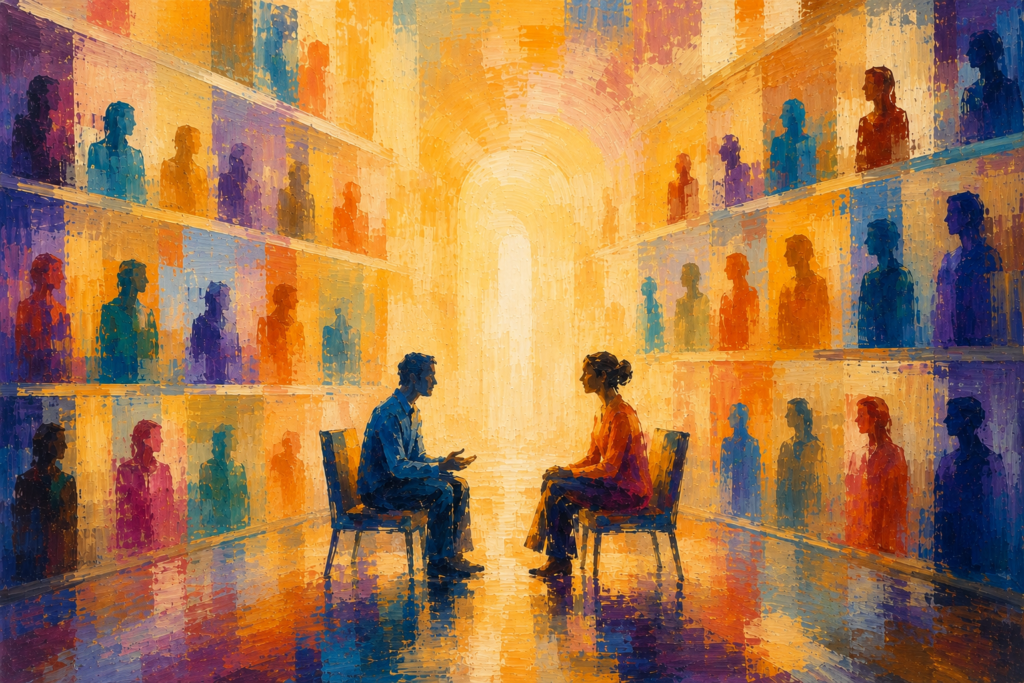
It’s a library where, instead of checking out a book, you check out a person.
For a short period of time, you sit down with someone whose life story is very different from your own.
Maybe it’s a combat veteran, or a refugee who fled a war-torn country. A former addict in recovery. Someone who has experienced homelessness or mental illness. Someone whose faith, background, or life experiences are very different from your own.
The goal isn’t to debate, or to convince, or to win.
The goal is simply to listen, and try to understand.
What a novel idea.
When I first learned about the Human Library, I immediately thought of one my favorite scenes from the television show Ted Lasso: “Be curious, not judgmental.” (click on it to watch if you haven’t seen it).
Those four words offer a perspective worth considering.
It seems that somewhere along the way, many of us have become experts at judgment. We can size up a person in seconds. We see a bumper sticker, a Facebook post, a news headline, or hear a remark at a social gathering, and we immediately think we know someone.
We place people into categories before we’ve heard their stories.
The problem is that every person is carrying around a story we haven’t heard yet.
As an estate planning attorney, I have had the privilege of sitting across the table from thousands of people over the years. One thing I’ve learned is that most people have chapters in their lives that aren’t visible from the cover.
The person who seems difficult may be carrying a burden no one else sees. The person who appears successful may be struggling with loneliness. The family member whose choices make no sense to us may have experienced challenges we know nothing about.
Life has a way of humbling our assumptions.
The older I get, the less certain I become that I know the whole story about anyone.
What I’ve discovered is that most people want the same things. They want to be loved. They want their families to be safe. They want to find purpose.
They worry about the people they care about. They carry regrets. And they hope for better days ahead.
The details of our stories may differ, but the themes are often remarkably similar.
Curiosity helps us discover that.
It doesn’t mean we have to agree with everyone. It doesn’t mean abandoning our values or pretending every opinion is correct. It simply means approaching another person with the possibility that there is something we don’t yet understand.
And when we do that, something interesting happens.
We often discover that we have more in common than we thought.
Perhaps the real lesson of the Human Library is that every person is a book. Some are easy to read. Some are challenging. Some surprise us. But almost all of them are more interesting than we first imagined if we’re willing to turn a few pages before making up our minds.
And if we keep reading, we often discover something else.
Beneath different backgrounds, different opinions, and different life experiences, we share many of the same hopes, fears, joys, and struggles. We celebrate life’s victories. We grieve its losses. We worry about the people we love. We search for meaning and connection.
We have more in common than we think.
In a world that often focuses on what divides us, perhaps the better question is not, “How are we different?” but “What can we learn from one another?”
The world could use a little more of that right now.