

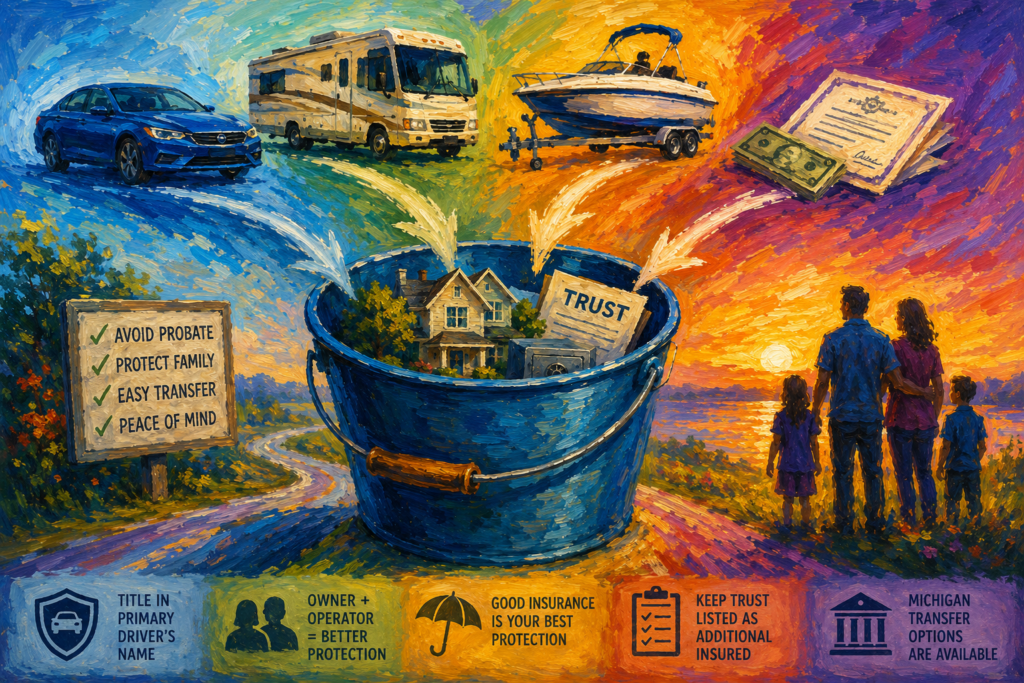
I recently received this question about whether cars and motorhomes should be titled into a trust:
“In Michigan, should our cars and motorhome be placed in our trusts? My husband and I have separate trusts. How do we know which trust to use? We were also told that putting a vehicle in only one spouse’s name could reduce liability if there’s an accident.”
This is a great question because there is a lot of misinformation floating around about vehicles and trusts.
The short answer is: For many Michigan families, vehicles are one of the few assets that often do not need to be titled in a trust.
But the answer is also more nuanced than you may have thought.
Michigan Gives Families Several Ways to Transfer Vehicles
Unlike many other assets, Michigan has special rules that often allow vehicles to be transferred after death without probate.
For example, Michigan allows certain vehicles to be transferred to a surviving spouse or next of kin using a Secretary of State form called the Certification from the Heir to a Vehicle.
In many situations, this allows a family member to transfer title without opening a probate estate. There are value limitations and other requirements ($100,000 that is adjusted by cost of living from 2026 on (see statute here)), so it is important to confirm eligibility with the Secretary of State or your attorney.
Because of this rule, many families are surprised to learn that a vehicle titled in an individual’s name does not automatically mean probate will be required.
The question then becomes: “What happens if my next of kin is default?” Is it simple? For example, to the spouse.
Or is it complicated? For example, to your 3 children and, if so, will they all agree and get along?
If complicated, you need to look at other options.
What About Transfer-on-Death Designations?
Michigan also allows transfer-on-death (TOD) beneficiary designations for vehicles.
For many people, this works very well. On your passing, the vehicle can be transferred to the named beneficiary.
However, TOD designations can become less attractive when there are multiple beneficiaries.
If Mom wants her three children to inherit her motorhome equally, a TOD designation can create practical problems.
The Secretary of State can transfer title to the three children, but it can’t make them agree on who can use the RV, when it gets sold, or how the proceeds should be divided.
In situations involving multiple beneficiaries, a trust may provide much better instructions and flexibility.
Which Trust Should Own the Vehicle?
When spouses have separate trusts, the general rule is simple:
The vehicle should normally be owned by the trust of the person who owns the vehicle.
If the vehicle is owned by the husband, it would typically be transferred to the husband’s trust. If the vehicle is owned by the wife, it would typically be transferred to the wife’s trust.
The answer becomes more complicated when vehicles are jointly owned or when spouses intentionally keep certain assets separate.
This is one reason trust funding should be coordinated with the overall estate plan rather than handled one asset at a time.
What About Liability?
This is where I often give clients advice that surprises them.
Michigan recognizes both owner liability and operator liability in many vehicle accident situations.
As a result, we often recommend titling a vehicle in the name of the primary driver.
Why?
Suppose a husband is the primary driver and the vehicle is titled in his name alone.
If he causes an accident, he may be both the owner and the operator. In many situations, only one spouse is involved in the lawsuit.
Compare that to a situation where one spouse owns the vehicle and the other spouse is the primary driver. In that case, you may have an owner and an operator, potentially bringing both spouses into the claim.
Every situation is different, and liability analysis can be fact-specific, but this is one reason we generally prefer titling a vehicle in the primary driver’s name.
More importantly, your first line of protection is usually not how the title is held. It is having adequate automobile insurance and an umbrella liability policy (which we almost always recommend because, for me, it helps me sleep better at night knowing that the billboard lawyers can’t get at my home or life savings).
What If We Do Put a Vehicle Into Our Trust?
A revocable living trust can own a vehicle.
In most situations, transferring a vehicle into your own revocable trust should not create a sales tax problem because you are not really selling the vehicle to someone else—you are simply changing the form of ownership. However, whenever a title transfer is involved, we recommend confirming the applicable Secretary of State requirements at the time of transfer.
If a vehicle is titled in your trust, there is another important step that is often overlooked:
Make sure your insurance company knows about the trust.
The trust should generally be listed with the insurance carrier as an additional insured or additional interest so that the ownership and insurance records match.
So What Do We Recommend?
For most families, the question is not:
“Should every vehicle be in my trust?”
The better question is:
“What is the easiest way to transfer this vehicle while keeping my overall estate plan coordinated?”
Sometimes that means using Michigan’s next-of-kin transfer rules.
Sometimes that means using a transfer-on-death designation.
Sometimes that means putting the vehicle into a trust.
And sometimes it means leaving the title exactly where it is.
The right answer depends on the vehicle, the family, and the goals of the estate plan.
A Final Thought
Estate planning works best when all the pieces fit together.
Your home, trusts, beneficiary designations, insurance coverage, powers of attorney, and vehicles all play a role.
The goal is not to force every asset into a trust.
The goal is to make things as simple as possible for the people you love when they need help the most.