

Quick Summary
Here’s a summary of an interesting economic trend that caught my attention.
Recent headlines have focused on rising credit card delinquencies and warnings that Americans may be headed toward another debt crisis.
But the reality appears to be more nuanced.
While some consumers are clearly struggling, most Americans are managing their debt better than many people realize. In fact, several measures suggest consumers as a whole are in stronger financial shape than they were before the 2008 financial crisis.
The bigger issue may not be too much credit. It may be that credit is becoming harder to get.
Why This Matters
At first glance, some of the numbers look concerning.
More than 13% of credit card balances reported by the New York Federal Reserve are seriously delinquent, meaning they are at least 90 days past due.
But other measures paint a different picture.
Consumer debt-service payments currently consume about 5.4% of disposable income, compared to more than 7% twenty years ago.
Similarly, less than 3% of credit card balances are at least 30 days past due, compared to more than 4% before the financial crisis and nearly 7% during the worst of that period.
In other words, most consumers appear to be handling their debt reasonably well.
So why do delinquency statistics seem so high?
Part of the answer may be lingering effects from the pandemic.
Government stimulus programs helped many consumers improve their credit profiles and take on new borrowing. As life returned to normal, some borrowers who were financially fragile before the pandemic began struggling again.
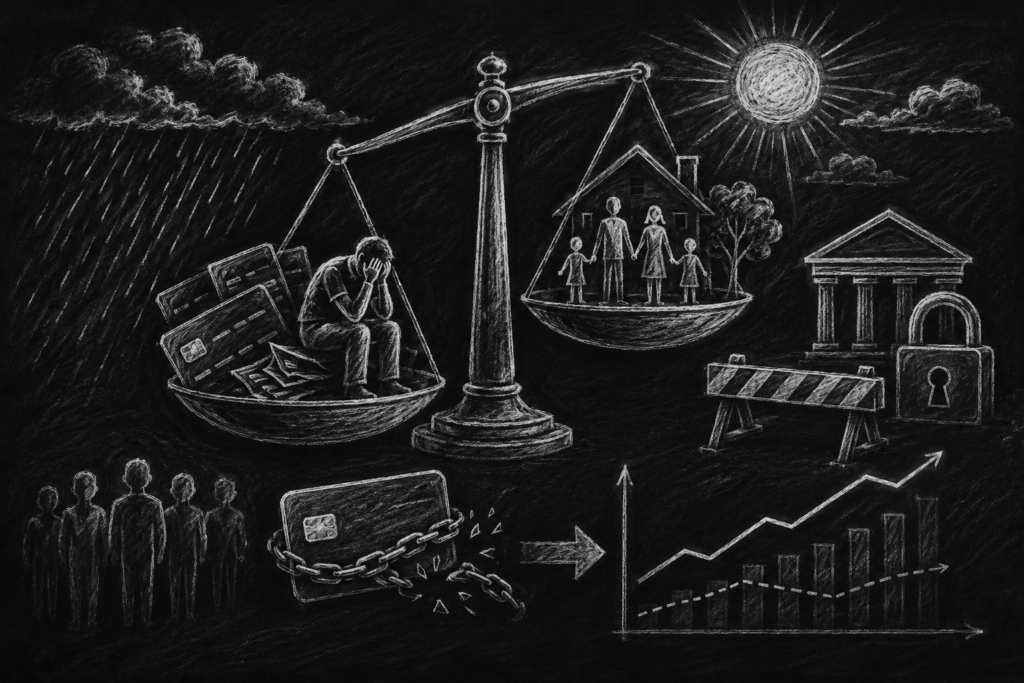
The result is an economy with two very different stories.
One group of consumers is experiencing financial stress.
Another, much larger group appears relatively healthy.
The labor market may also be contributing to the problem.
Jobs remain relatively stable. But when someone loses a job today, it can take longer to find a new one. That means some borrowers who fall behind are having a harder time recovering.
Banks have responded by tightening lending standards.
They are becoming more selective about who receives credit cards and who qualifies for larger credit limits.
That may be creating a different challenge.
Historically, excessive lending has created problems for the economy. Today, some economists believe the opposite may be occurring. Credit card lending growth has recently lagged behind overall economic growth, suggesting consumers may have less access to credit than they once did.
For businesses and consumers alike, access to responsible credit can help smooth out unexpected expenses, bridge temporary financial gaps, and support economic growth.
Simple Lesson
The headlines don’t always tell the whole story. Sometimes the real issue isn’t too much debt—it’s understanding who is struggling, who is thriving, and how access to credit is changing.
Action Step
Take a few minutes to evaluate your own financial picture:
- Do you know how much high-interest debt you currently carry?
- Could you handle a temporary loss of income?
- Do you have an emergency fund for unexpected expenses?
- Have rising costs affected your long-term financial goals?
Financial health isn’t measured by headlines. It’s measured by how prepared you are for whatever comes next.
If you’d like to talk about your estate plan or long-term care planning, we’re always happy to help.
Visit www.MichiganEstatePlans.com or call us at (517) 548-7400.